
Quick Quote

A clear breakdown of when each service fits your freight
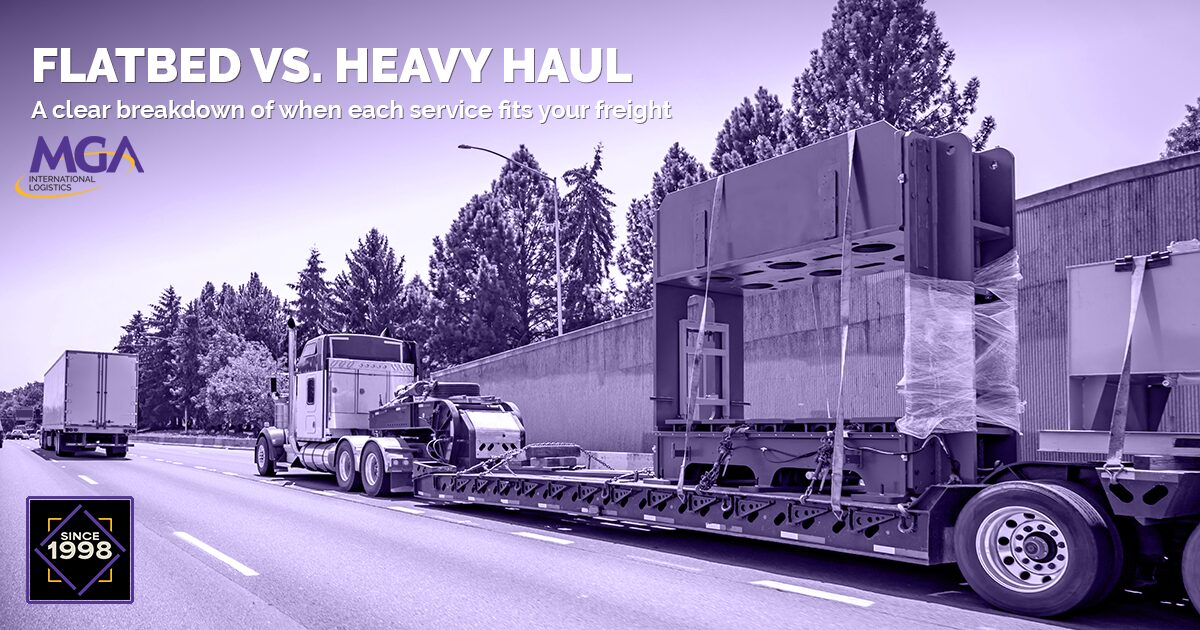
Choosing the right transportation method for oversized or heavy cargo can make or break your shipping timeline and budget. Many shippers struggle to determine whether their freight requires flatbed trucking services or heavy haul capabilities. This decision impacts everything from costs to transit times to regulatory compliance. Understanding the key differences between these two specialized transportation options helps you select the most efficient solution for your specific shipping needs.
Flatbed trucking services handle cargo that fits within standard legal weight and dimension limits. These trailers feature an open deck without sides or a roof, measuring typically 48 to 53 feet in length. Flatbed carriers transport loads up to 48,000 pounds and dimensions that stay within legal limits of 8.5 feet wide, 8.5 feet high, and 53 feet long. This service works perfectly for construction materials, machinery, steel products, and lumber that require easy loading from multiple angles.
Heavy haul transportation tackles freight that exceeds standard legal limits for weight, width, height, or length. These shipments demand specialized equipment, permits, escort vehicles, and route planning. Heavy haul trucking companies move industrial equipment, large machinery, prefabricated structures, and other oversized items that cannot fit on standard trailers. The complexity of permits and regulations makes heavy haul significantly more involved than standard flatbed shipping.
Your cargo’s specifications determine whether you need flatbed trucking companies or heavy haul specialists. Start by measuring your freight’s dimensions and calculating its total weight. If your shipment stays within 48,000 pounds and fits the standard dimension limits, flatbed transportation services will handle it efficiently. Most construction materials, palletized freight, and standard machinery fall into this category.
Shipments exceeding these parameters require heavy haul capabilities. For example, a 60,000-pound excavator or a load that’s 12 feet wide needs heavy haul equipment and permitting. Consider the route requirements as well. Heavy haul often requires route surveys to identify bridge clearances, road restrictions, and potential obstacles. Your shipping timeline matters too because permit acquisition for heavy haul can add several days to your schedule.
| Factor | Flatbed Trucking | Heavy Haul Trucking |
| Base Rate | Standard per-mile rate | Premium per-mile rate |
| Permits | None required | State/provincial permits required |
| Escort Vehicles | Not needed | Often mandatory |
| Route Planning | Standard routing | Specialized route surveys |
| Transit Time | Faster turnaround | Longer due to permitting |
| Equipment | Standard trailers | Specialized trailers (RGN, lowboy) |
Flatbed transportation services offer more predictable pricing because they operate within standard regulations. You pay for mileage, fuel surcharges, and standard loading/unloading services. The straightforward nature of flatbed shipping keeps costs manageable and timelines consistent. Most flatbed shipments can be quoted and executed quickly without extensive planning.
Heavy haul pricing includes multiple additional cost factors beyond basic transportation. Permit fees vary by state or province and can range from hundreds to thousands of dollars per shipment. Escort vehicles add hourly or daily charges. Route surveys conducted by engineers add planning costs. Specialized equipment like removable gooseneck trailers or multi-axle configurations commands premium rates. The complexity of heavy haul means costs can vary significantly based on your specific cargo and route.
Construction companies rely heavily on both services depending on project requirements. Standard building materials like lumber, roofing supplies, and palletized bricks move efficiently via flatbed trucking services. When construction projects need large cranes, bulldozers, or prefabricated building sections, heavy haul becomes necessary. General contractors often use flatbed carriers for regular deliveries and reserve heavy haul for specialized equipment moves.
Manufacturing facilities use flatbed transportation services for routine machinery shipments, raw materials, and finished products. Steel mills ship coils, beams, and pipes on flatbeds daily. When manufacturers relocate production lines or install massive processing equipment, they turn to heavy haul trucking companies. The oil and gas industry frequently requires heavy haul for pipeline sections, drilling equipment, and refinery components that exceed standard dimensions.
Standard flatbed trailers come in several configurations but share common characteristics. The open deck allows loading from any side using cranes or forklifts. Standard flatbeds measure 48 or 53 feet long with a deck height around 5 feet. These trailers use chains, straps, and tarps to secure and protect cargo. The simplicity of flatbed equipment means wide availability and flexible scheduling across North America.
Heavy haul equipment includes specialized trailer types designed for extreme loads. Lowboy trailers sit lower to the ground, accommodating taller cargo while staying under height restrictions. Removable gooseneck trailers allow ground-level loading of tracked equipment. Multi-axle configurations distribute weight across more wheels to handle heavier loads. Some heavy haul projects require modular trailers that can be configured with dozens of axles for massive industrial components.
Flatbed trucking companies operate under standard commercial vehicle regulations. Drivers need commercial licenses but don’t require special endorsements beyond standard qualifications. Hours of service rules, weight station compliance, and basic safety regulations apply. The regulatory simplicity allows flatbed carriers to operate efficiently across state and provincial borders without extensive advance planning.
Heavy haul faces significantly more regulatory scrutiny. Each state or province issues specific permits based on load dimensions and weight. Some jurisdictions require notifications to highway departments days or weeks in advance. Travel restrictions often limit heavy haul to specific hours or days, avoiding rush hour and weekend traffic. Bridge authorities must approve routes to ensure structural capacity. International shipments crossing between the United States and Canada face additional customs and transportation authority requirements.
MGA International serves as a comprehensive transportation and logistics provider offering cross-border door-to-door delivery through LTL, FTL, and specialized flatbed services. Our access to highly-skilled drivers and meticulously-maintained vehicles has secured our place as one of the leading trucking companies on the continent. As one of the fastest-growing and most reliable entities in the transportation and logistics sector, MGA International stands out as a premier flatbed transportation carrier in Canada. Renowned as a trustworthy freight shipping company, we are committed to delivering a safe, cost-effective, and uninterrupted transportation experience for all types of cargo.
Ready to ship your freight with confidence? Contact MGA International or request your free quote to discuss your flatbed or heavy haul transportation needs today.

Greg Grimes got it done. I had an unusual shipment that he took on seriously and professionally. Greg was very responsive and communicative, worked many different angles to get me a good price, and overcame several logistical challenges. I would definitely use MGA again.
We have made several trips to Toronto for the 2013 PGA Championship and over the course of those trips we have gotten to know the principles of this organization well. They are headquartered in Toronto and are great people. If you need to reach out to them, ask for Greg or Brad Grimes and let them know you heard of them through this note and they will take good care of you.
Can count on MGA for all my shipping requirements. Fantastic personnel and service.
