


Flatbed Freight Shipping: A Practical Overview
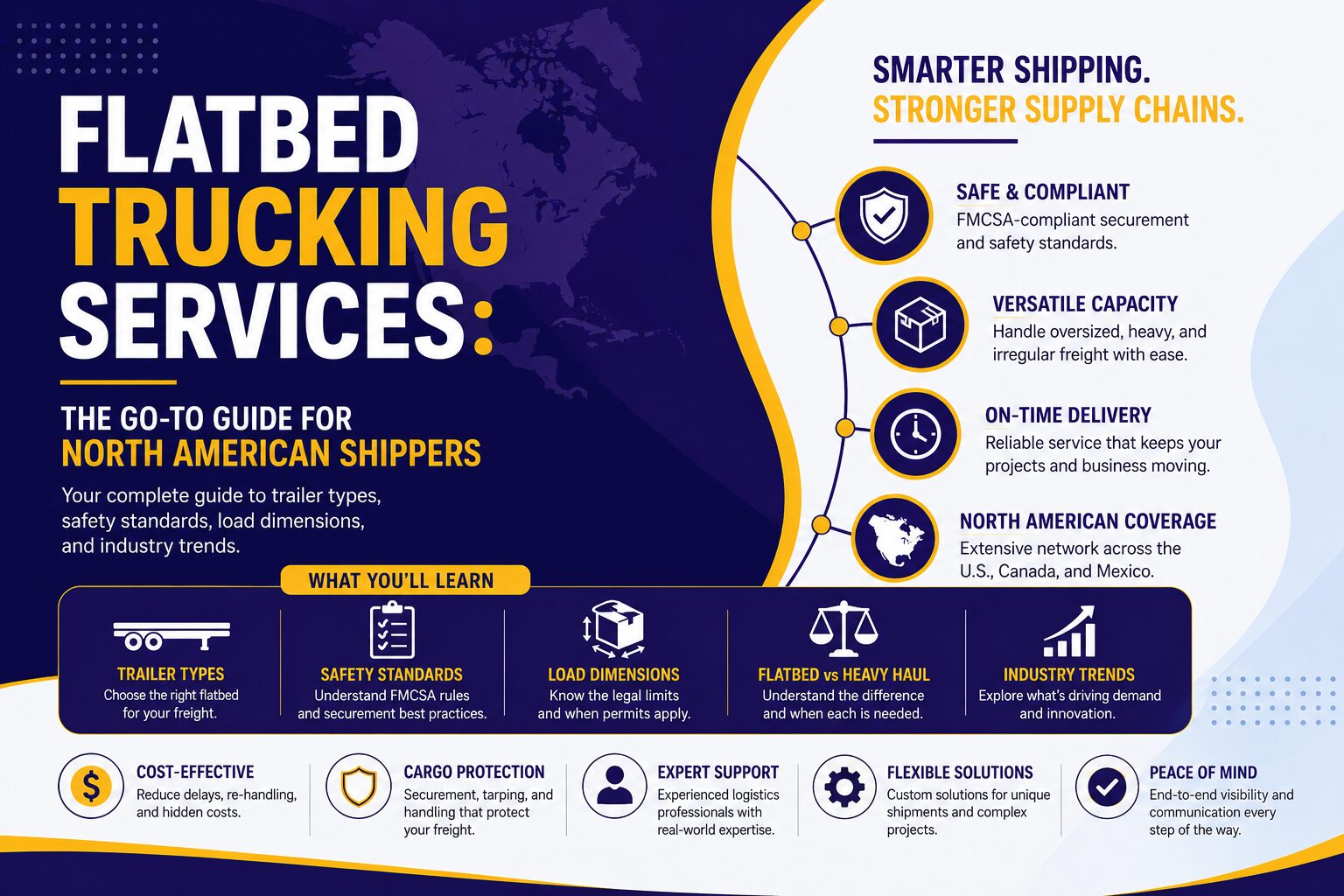
As oversized freight demand grows across construction, energy, and manufacturing, flatbed trucking services have become one of the most critical and most misunderstood parts of the North American supply chain. This guide establishes a clear, practical reference for shippers navigating open deck freight for the first time or optimising an existing logistics operation.
We cover the full flatbed picture: trailer types and legal load dimensions, FMCSA safety and securement standards, how flatbed carriers differ from heavy haul providers, cargo protection best practices, day-to-day operational benefits, and the industry trends reshaping demand from the energy transition to e-commerce growth and technology integration.
The main takeaway: Flatbed trucking is not just a fallback when freight will not fit in a box. It is a purpose built solution that saves time, reduces cost, and simplifies logistics for businesses shipping oversized or irregular cargo. Choosing the right flatbed carrier, understanding your load dimensions, and knowing when heavy haul is required are the three decisions that determine whether your freight moves smoothly or expensively.
When your freight is too large, too heavy, or too irregularly shaped for a standard enclosed trailer, flatbed trucking services become the backbone of your supply chain. From steel coils and construction beams to industrial machinery and modular building sections, flatbed freight shipping is the solution that industries across North America depend on — day in and day out.
This guide brings together everything you need to know about flatbed transportation services: what they are, how they work, what the safety standards look like, how dimensions and load limits are governed, how flatbed carriers compare to heavy haul providers, and what trends are reshaping the industry. Whether you’re a first-time shipper or a seasoned logistics manager, this is your definitive reference for flatbed trucking.
What Is Flatbed Trucking and How Does It Work?
Flatbed trucking involves transporting cargo on an open-deck trailer—a flat platform with no sides, roof, or walls. This open design allows cargo to be loaded and unloaded from the top, sides, or rear using cranes, forklifts, or other heavy equipment.
Standard flatbed trailers are typically 48 to 53 feet long, with a deck height of approximately 5 feet. They can legally carry loads up to 48,000 pounds within standard dimension limits of 8.5 feet wide, 8.5 feet high, and 53 feet long. Flatbed carriers use chains, straps, and tarps to secure and protect cargo throughout transit.
Because of this design, flatbed trucking companies can transport a wide range of oversized and irregularly shaped freight, including fabricated steel beams, highway support structures, construction equipment, agricultural machinery, wind turbine components, and other large industrial loads.
MGA International provides open-deck freight solutions across North America, helping businesses move oversized, heavy, and specialized cargo with reliable transportation services tailored to their shipping requirements.
“Greg was quickly able to supply us with a transport truck with the equipment we needed for a reasonable price. Everything went well and according to plan. The driver was very friendly, and our 30,000 lbs of glass was in perfect condition upon arrival.”
— Morgan Staal (Google, August 2022)
Need a flatbed solution for your freight? MGA International has handled everything from fragile industrial glass to oversized steel — safely and on schedule. Request a Free Quote →
Understanding Flatbed Trailer Types and Load Dimensions
Not all flatbed trailers are built the same. Choosing the right trailer configuration is essential for safe, legal, and cost-effective shipping. For a detailed breakdown of what each trailer type can legally carry, read our full guide on flatbed trailers and open-deck load dimensions.
Standard Flatbed Trailers are the most common configuration, measuring 48 or 53 feet in length. These trailers handle the widest variety of general oversized freight — lumber, steel products, machinery, palletized goods, and construction materials.
Step Deck Trailers feature a lower deck that provides additional height clearance. They’re ideal for cargo that slightly exceeds the standard height limit on a flat deck but doesn’t require a full lowboy configuration.
Lowboy Trailers sit much closer to the ground, making them ideal for tall, heavy cargo like large excavators and transformers that would exceed height restrictions on standard flatbeds.
Removable Gooseneck (RGN) Trailers allow the front section to detach, enabling ground-level loading of tracked equipment that cannot be lifted onto a trailer. These are common in heavy haul operations.
Standard Dimensional Limits at a Glance
| Dimension | Standard Legal Limit |
| Width | 8.5 feet |
| Height | 8.5 feet |
| Length | Up to 53 feet |
| Weight | Up to 48,000 lbs |
Loads exceeding these limits require special permits and, in many cases, pilot escort vehicles. Route planning becomes critical when oversized dimensions are involved, as certain bridges, tunnels, and roads impose additional restrictions. It’s wise to work with experienced flatbed transportation services that understand the permit landscape in every jurisdiction your freight will travel through.
For cross-border shipments between the United States and Canada, regulatory requirements add another layer of complexity. Canadian provinces enforce axle weight regulations that differ from American state laws, and customs documentation must be precise and complete. Working with a carrier that has established cross-border experience is non-negotiable for smooth transit.
Not sure which trailer type fits your load? Our team will assess your freight specs and match you with the right equipment — standard flatbed, step deck, lowboy, or RGN. Talk to a Flatbed Specialist →
Industries That Rely on Flatbed Transportation Services
The versatility of flatbed trucking makes it indispensable across a wide range of industries.Construction is the most prominent user of flatbed freight shipping. Job sites depend on the timely delivery of backhoes, cranes, scaffolding, lumber, steel beams, roofing materials, solar panels, and piping. Flatbed carriers can load and unload from any direction, making deliveries to constrained job sites far more practical than enclosed trailer alternatives. When the project wraps, the same equipment needs to be retrieved and moved to the next site; flatbed trucking handles both directions seamlessly.
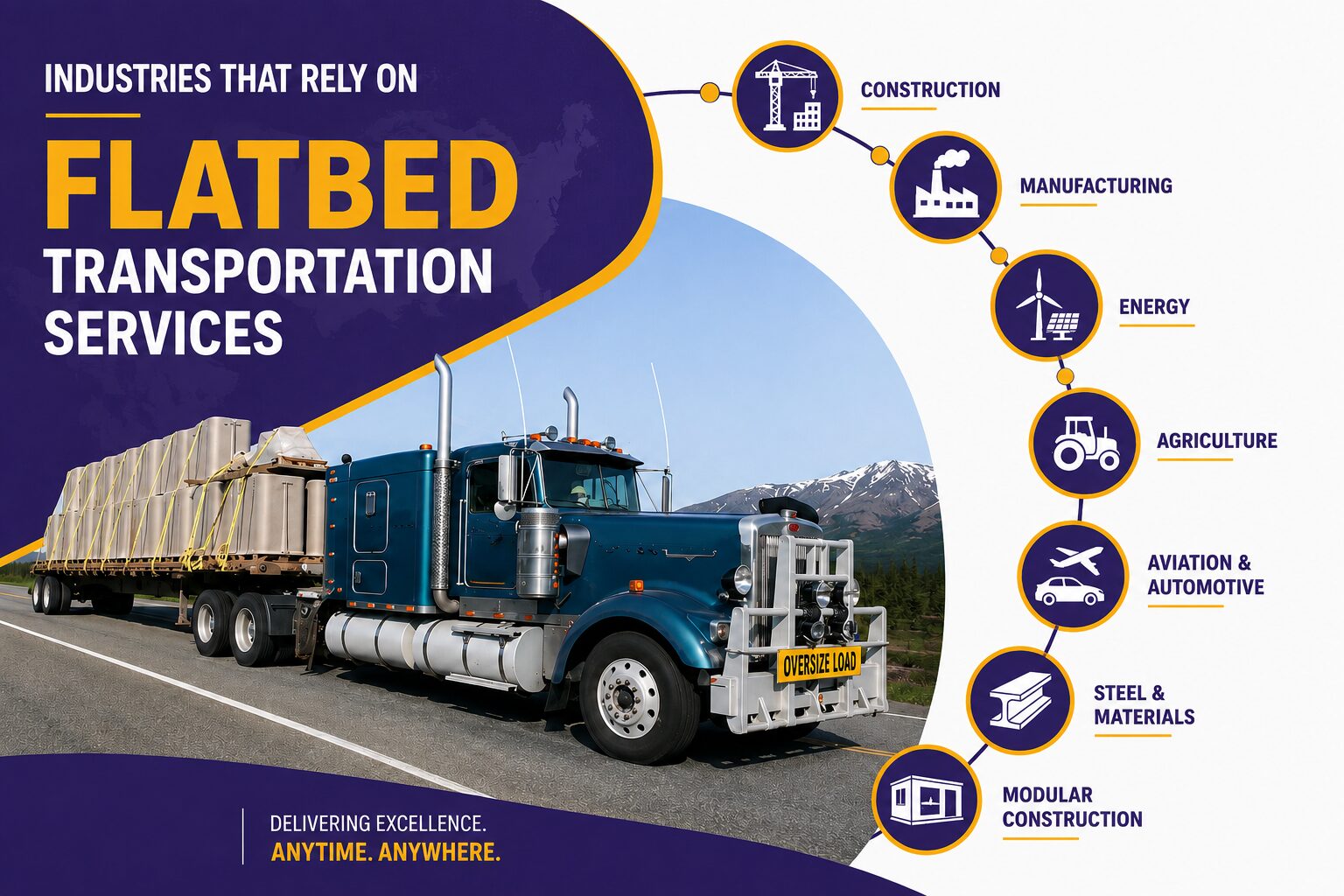
Manufacturing relies on flatbed transportation services to move conveyors, CNC machines, crushers, fabricated steel, and raw materials. When facilities relocate production lines or take delivery of large processing equipment, flatbed trucking companies provide the only practical solution.
Energy and renewable power are growing drivers of flatbed demand. Pipelines, drilling equipment, wind turbine components, transformer units, and generator assemblies are all oversized freight that requires open-deck solutions. The energy transition is creating significant new demand as wind and solar infrastructure expand across North America.
Agriculture depends on flatbed carriers during planting and harvest seasons, when large combines, tractors, irrigation systems, and other oversized farming equipment need to move between locations quickly and safely.
Aviation and Automotive industries move airplane parts, disassembled vehicles, and specialty components via flatbed trucking — cargo that simply cannot be accommodated any other way.
Steel and Materials industries ship coils, I-beams, pipes, and metal sheets daily on flatbeds. The open deck design enables the use of coil racks and specialized tie-down systems that keep metal products secure through every mile of transit.
Modular Construction is an emerging growth area for flatbed freight shipping. Prefabricated wall panels, roof trusses, bathroom pods, and entire building sections require open-deck transport because they exceed standard enclosed trailer dimensions. Flatbed trucking is the enabler of the modular building industry’s rapid North American expansion.
“All the great service needs that a company could meet for a customer, MGA International exceeded them. Their entire staff was extremely responsive, helpful, and most importantly, they kept me informed the entire process. I was also impressed by the driver and how much care he put into securing our goods.”
— Thi Nguyen (Google, November 2021)
Shipping for construction, manufacturing, or energy? MGA International serves all major industrial sectors across North America with purpose-built flatbed solutions. View Our Flatbed Services →
Safety, Compliance, and Load Securement Standards
Safety is non-negotiable in flatbed transportation. Unlike enclosed trailers, open-deck freight is exposed to wind, weather, and road forces with no physical barriers. A single failed anchor point can cascade into complete load failure during emergency braking. The stakes are real — for the driver, the cargo, and every other vehicle on the road. Our detailed post on flatbed protocols, safety compliance, and load control walks through the full framework professional carriers follow.
FMCSA Load Securement Requirements
The Federal Motor Carrier Safety Administration (FMCSA) mandates specific securement standards for all flatbed operations. Every load requires a minimum of four tie-down points, with additional restraints required for heavier cargo. Load types dictate the securement method — chains for heavy machinery, straps for palletized goods, and specialized blocking and bracing for irregular shapes.
Professional flatbed trucking companies go beyond regulatory minimums. Experienced drivers understand how to calculate the center of gravity, anticipate load shifting during acceleration and cornering, and select the appropriate securement strategy based on cargo characteristics. This expertise comes from years of hands-on flatbed operations.
Pre-Trip Inspection Protocols
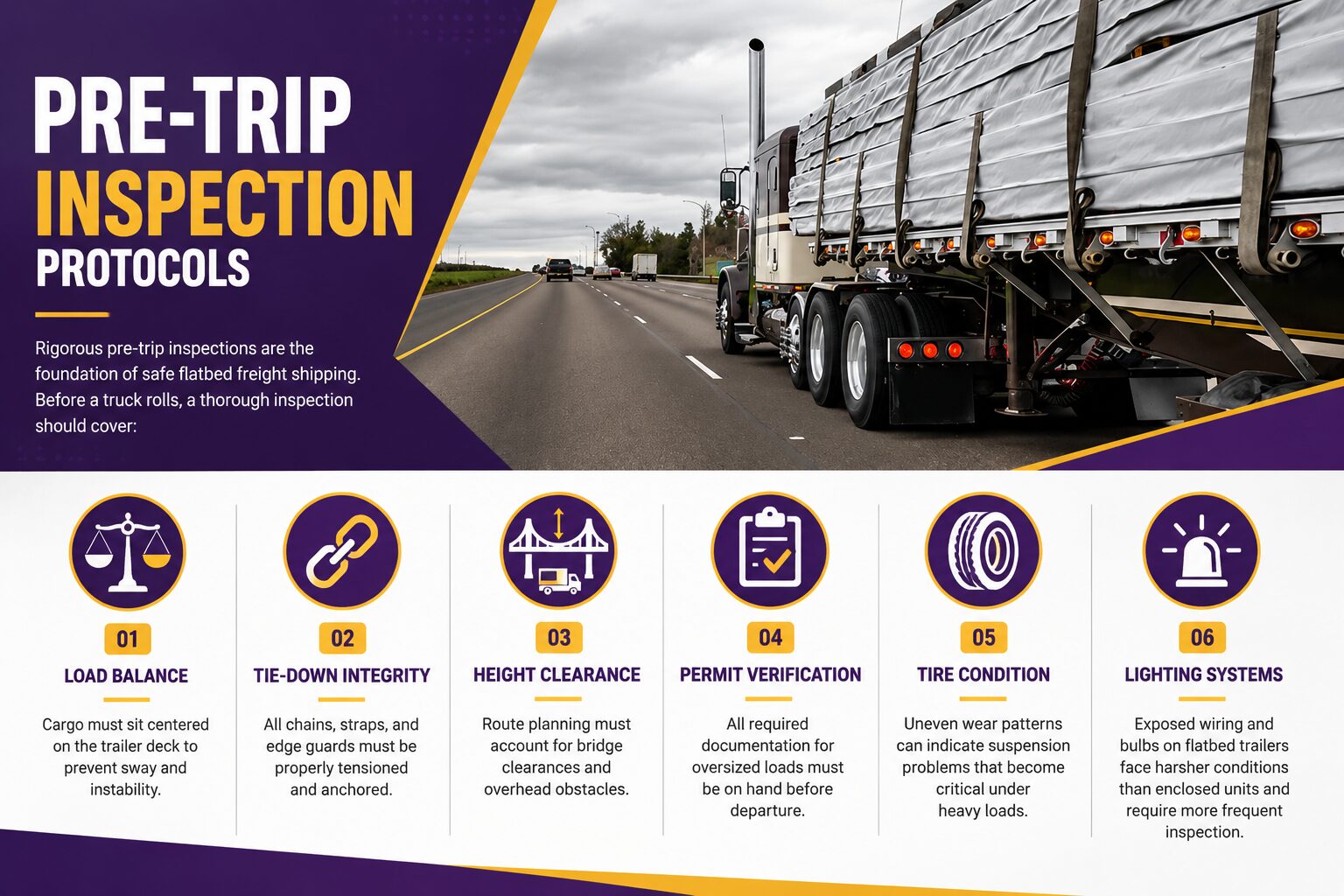
Rigorous pre-trip inspections are the foundation of safe flatbed freight shipping. Before a truck rolls, a thorough inspection should cover:
- Load balance — Cargo must sit centered on the trailer deck to prevent sway and instability
- Tie-down integrity — All chains, straps, and edge guards must be properly tensioned and anchored
- Height clearance — Route planning must account for bridge clearances and overhead obstacles
- Permit verification — All required documentation for oversized loads must be on hand before departure
- Tire condition — Uneven wear patterns can indicate suspension problems that become critical under heavy loads
- Lighting systems — Exposed wiring and bulbs on flatbed trailers face harsher conditions than enclosed units and require more frequent inspection
Tarping and Weather Protection
Flatbed trailers offer no built-in protection from the elements. Rain, snow, and wind can compromise load integrity and damage cargo, particularly steel and lumber products. Professional flatbed carriers deploy weather-resistant tarps when required, ensuring full coverage and tight application throughout transit. Knowing when and how to tarp properly is a skilled trade — and experienced flatbed drivers treat it as such.
Cross-Border Compliance
Cross-border shipments between the U.S. and Canada require careful compliance management. Weight limits, dimensional restrictions, axle weight regulations, and documentation requirements vary by jurisdiction. Hours-of-service rules differ, and some jurisdictions require advance notification for oversized loads — sometimes days or weeks ahead. Working with flatbed trucking companies that have established cross-border expertise eliminates costly delays and compliance violations at the border.
“Greg Grimes solved a tricky shipping problem for us that 6 other shippers could not accomplish. He gave us white-glove service at a fantastic rate. He and his team were very responsive and great to work with. MGA is my top vendor for shipping needs in the US and Canada.”
— Suzanne Cohan
Compliance-ready flatbed shipping across the US and Canada MGA’s team manages all permit requirements, securement protocols, and cross-border documentation — so you don’t have to.
Get a Compliant Flatbed Quote →
Protecting Cargo During Flatbed Transportation
Because flatbed trailers offer no physical enclosure, cargo protection requires active planning and execution — not passive containment. Exposure to weather, road vibration, wind resistance, and physical impact during loading and unloading all create risks that experienced flatbed carriers are trained to manage.
Load securement is the first and most critical layer of protection. Professional flatbed trucking companies use chains, straps, and edge guards calibrated to FMCSA standards. Heavy machinery requires heavy-duty chains anchored at multiple points. Steel products use coil racks and specialized strapping to prevent rolling. Palletized goods rely on friction-reducing edge guards and tensioned straps to prevent movement.
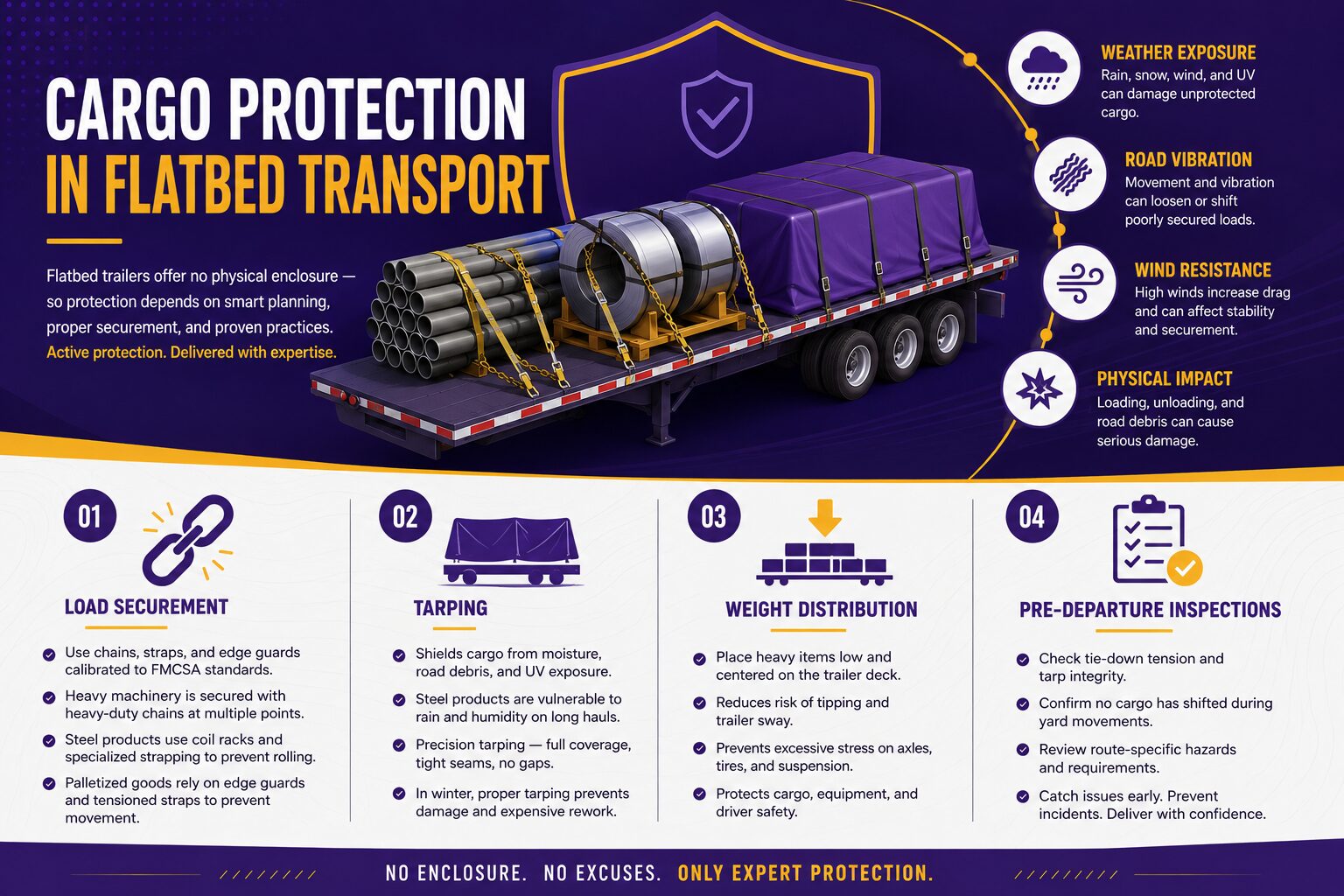
Tarping protects cargo from moisture, road debris, and UV exposure. Steel products are particularly susceptible to surface damage from rain and humidity during long-haul transport. Experienced flatbed drivers apply tarps with precision — full coverage, tight seams, and no gaps that wind can exploit. In winter conditions across North America, proper tarping is the difference between cargo that arrives in perfect condition and cargo that requires costly rework.
Weight distribution protects both the cargo and the vehicle. Positioning heavy items low and centered on the trailer deck reduces the risk of tipping and trailer sway. Improper weight distribution puts excessive stress on axles, tires, and suspension components — increasing both safety risk and equipment wear.
Pre-departure inspections catch problems before they become incidents. Checking tie-down tension, verifying tarp integrity, confirming that no cargo has shifted during initial yard movements, and reviewing route-specific hazards are all standard practices at quality flatbed transportation companies.
“You have consistently been on time, delivered product free of any damage, and the communication has been excellent.”
— Greg Alford
Flatbed Trucking vs. Heavy Haul: Choosing the Right Service
One of the most common decisions shippers face is whether their freight needs standard flatbed trucking services or heavy haul capabilities. Getting this wrong costs time and money. For a side-by-side breakdown with real-world examples, see our dedicated post on flatbed vs. heavy haul trucking.
What Standard Flatbed Trucking Covers
Flatbed carriers handle cargo that fits within standard legal weight and dimension limits. If your shipment stays within 48,000 pounds, 8.5 feet wide, 8.5 feet high, and 53 feet long, flatbed transportation services will handle it efficiently. Construction materials, palletized freight, standard machinery, lumber, and steel products almost always fall into this category.
Flatbed freight shipping offers predictable, competitive pricing. You pay for mileage, fuel surcharges, and standard loading and unloading services. Shipments can typically be quoted and dispatched quickly, without the advance planning required for heavy haul moves.
When Heavy Haul Is Required
Heavy haul transportation applies when freight exceeds the standard legal limits in any dimension, weight, width, height, or length. A 60,000-pound excavator, a 14-foot-wide industrial module, or a 90-foot-long wind turbine blade all fall into heavy haul territory. These shipments require specialized equipment, state and provincial permits, possible escort vehicles, and detailed route surveys to identify bridge clearances and road restrictions.
| Factor | Flatbed Trucking | Heavy Haul Trucking |
| Base Rate | Standard per-mile rate | Premium per-mile rate |
| Permits | Not required | State/provincial permits required |
| Escort Vehicles | Not needed | Often mandatory |
| Route Planning | Standard routing | Specialized engineer-led route surveys |
| Transit Time | Faster turnaround | Longer due to the permitting process |
| Equipment | Standard flatbed trailers | Lowboy, RGN, multi-axle configurations |
| Regulatory Load | Standard commercial rules | Complex multi-jurisdiction requirements |
The right choice depends on your cargo’s exact dimensions and weight. When in doubt, measure first — then consult with your flatbed transportation carrier before booking.
“Greg Grimes got it done. I had an unusual shipment that he took on seriously and professionally. Greg was very responsive and communicative, worked many different angles to get me a good price, and overcame several logistical challenges. I would definitely use MGA again.”
— Ryan Brown
Flatbed or heavy haul — not sure which fits your load? Share your freight specs with MGA’s team and we’ll recommend the right service within 24 hours. Submit Your Freight Details →
How Flatbed Trucking Simplifies Day-to-Day Business Operations
For businesses that ship oversized or irregularly shaped freight regularly, partnering with reliable flatbed trucking companies isn’t just a logistics decision — it’s a competitive advantage. Read how flatbed trucking simplifies day-to-day operations for a closer look at the operational impact.
Time savings are perhaps the most immediate benefit. Loading and unloading a flatbed is significantly faster than maneuvering cargo through the tight confines of an enclosed trailer. Cranes and forklifts can access the trailer from any direction, eliminating dock dependency and reducing turnaround time at both origin and destination. For manufacturing facilities with just-in-time production schedules, that speed difference directly impacts output.
Cost efficiency follows from that speed. Less time loading means lower labour costs, faster equipment turnover, and tighter delivery windows. The ability to consolidate oversized shipments onto a single flatbed — rather than breaking cargo down for multiple enclosed trailer loads — further reduces per-unit shipping costs.
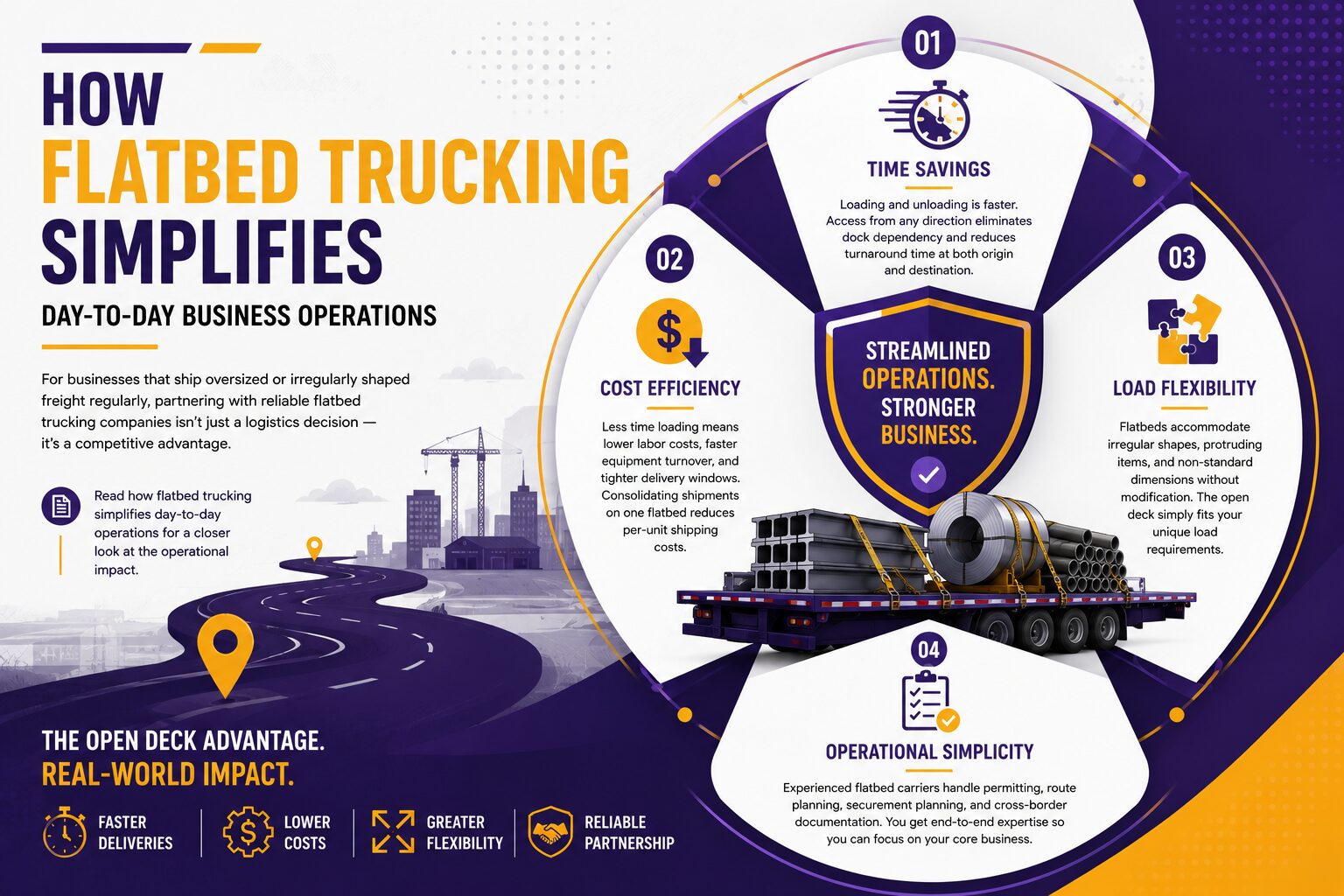
Load flexibility is a practical advantage that often goes underappreciated. Unlike enclosed trailers, flatbed trailers accommodate irregular shapes, protruding items, and non-standard dimensions without modification. A steel fabricator shipping custom structural components doesn’t need to worry about whether the load fits through a trailer door — the open deck simply accommodates it.
Operational simplicity is the longer-term benefit. When you work with experienced flatbed carriers that specialize in your cargo type and geography, the complexity of logistics management decreases. Your carrier handles permitting, route planning, securement planning, and cross-border documentation. You focus on your core business.
“Great company to work with, made moving multiple shipments across the country seamless and easy.” — Wyatt Andersen (Google, August 2023)
“I love how they are always quick to respond. Very fair rates and always helpful even with last minute requests.” — Teresa Raffone (MGA International Customer)
Ready to simplify your freight operations? Call MGA International at 844-334-0039 or request an online quote — we respond fast, even for last-minute shipments. Request a Quote →
Flatbed Trucking Industry Trends Shaping the Future
The flatbed trucking market is not static. Several forces are reshaping demand, operations, and the competitive landscape across North America. For the full picture of where the sector is heading, see our post on flatbed trucking industry trends.
Construction and infrastructure growth continue to be the primary engines driving flatbed freight shipping demand. Both commercial and residential construction activity remains strong, generating a sustained need for materials and equipment that only flatbed carriers can move. Government infrastructure investment programs add further momentum, with large-scale bridge, highway, and utility projects creating demand for oversized freight transport.
The energy transition is a rapidly growing source of flatbed demand. Wind farms, solar installations, battery storage facilities, and grid modernization projects all require large, heavy, and irregular components. Wind turbine blades, nacelles, tower sections, and transformer units are among the most challenging and rewarding loads in the flatbed sector — and demand for them is accelerating.
E-commerce and online retail growth are creating an unexpected tailwind for flatbed trucking. As consumers increasingly purchase large furniture items, appliances, and building materials online, retailers are using flatbed transportation services to fulfill those larger-format orders — a segment that didn’t exist at scale a decade ago.
Technology integration is changing how flatbed carriers operate. Electronic logging devices (ELDs) have become standard, improving driver hours compliance and fleet management. GPS tracking and real-time visibility platforms give shippers accurate shipment status throughout transit. Load planning software helps optimize weight distribution and tie-down configurations before the truck leaves the yard.
Driver expertise and workforce development remain critical industry priorities. Flatbed operations demand more physical skill and technical knowledge than standard dry van driving. Drivers must understand load physics, securement mechanics, tarping techniques, and permit compliance. Carriers that invest in training pipelines are positioning themselves for long-term competitive advantage.
How to Choose the Right Flatbed Trucking Company
Not all flatbed carriers deliver the same level of service. Choosing the right partner for your freight needs involves evaluating several key criteria.
Experience and track record matter enormously in flatbed freight shipping. A carrier with 25 or more years of operation has navigated economic cycles, regulatory changes, and evolving customer requirements. That institutional knowledge translates directly into fewer problems for your shipments.
Fleet quality and equipment variety determine whether a carrier can handle your specific freight. Look for companies that maintain a diverse fleet — standard flatbeds, step decks, lowboys, and RGN trailers — and keep that equipment in excellent condition.
Safety ratings and compliance history are publicly available for carriers operating in North America. Carriers with strong safety records protect your cargo and your company’s liability exposure.
Cross-border capability is essential if your freight moves between the United States and Canada. Carriers with established cross-border expertise handle customs documentation, border clearances, and jurisdiction-specific weight and dimension rules without the delays that inexperienced carriers cause.
Responsiveness and communication separate good carriers from great ones. When a challenge arises mid-shipment, proactive communication keeps you in control. Look for carriers that invest in customer service as seriously as they invest in equipment.
“These guys are the best under pressure. They just get it done, consistently, like nobody else!”
— Matt R
“MGA team always provides good services. Delivery service is always prompt and we never had any issues with the company.” — Michael Doyle
MGA International: Your Flatbed Transportation Partner Across North America
With over 25 years of experience, MGA International is one of North America’s most trusted flatbed trucking companies. Based in Etobicoke, Ontario — within 130 kilometers of the U.S. border — we are strategically positioned to serve both domestic Canadian shippers and cross-border customers moving freight between Canada and the United States.
Our flatbed transportation services span the full range of open-deck solutions: standard flatbeds, step decks, lowboys, and RGN trailers. Whether your freight is a single piece of construction equipment or a recurring stream of industrial shipments, our team builds the right solution around your specific requirements.
We provide access to drivers with decades of flatbed expertise, supported by a carrier network whose equipment is meticulously maintained and consistently inspected. We stay current with evolving regulations in both the United States and Canada, ensuring that every load we move is compliant, properly documented, and safely secured from origin to destination.
Our customers rate us 4.8 out of 5 stars — and that rating is built on thousands of shipments handled without compromise.
“I would give more than 5 stars if I could. MGA is the best! Thank you Greg & the team for making the entire process headache-free and coming through when we need you!” — Taras K (Google, April 2023) ★★★★★
“I know my freight is in good hands.”— Charmaine Parsons (MGA International Customer)
Ship your flatbed freight with North America’s most trusted carrier. Over 25 years. 4.8-star rated. Cross-border experts. Get Your Free Flatbed Quote → Or call us directly: 844-334-0039 | info@mgainternational.com
What are the standard weight and dimension limits for flatbed carriers?
Standard flatbed trailers carry loads up to 48,000 pounds, with dimension limits of 8.5 feet wide, 8.5 feet high, and up to 53 feet long. Loads exceeding these limits require special permits and may need escort vehicles.
How does flatbed trucking differ from heavy haul transportation?
Flatbed trucking handles freight within standard legal limits without requiring special permits. Heavy haul applies when freight exceeds those limits in weight, width, height, or length, requiring specialized equipment, permits, and route surveys.
What safety regulations govern flatbed transportation services?
The FMCSA sets minimum securement standards including a minimum of four tie-down points per load, with additional requirements based on cargo weight. Carriers must also comply with state and provincial weight and dimension regulations, hours-of-service rules, and equipment inspection requirements.
Can flatbed trucking companies handle cross-border shipments between Canada and the US?
Yes, but only carriers with established cross-border expertise should be trusted with these moves. Canada and the U.S. maintain different weight limits, axle weight regulations, and documentation requirements. Experienced cross-border flatbed carriers manage permits, customs documentation, and border clearances efficiently.
How do I know if my freight needs a standard flatbed or a specialized trailer like a step deck or lowboy?
Start with your freight's dimensions and weight. If your load exceeds standard height limits, a step deck or lowboy may provide the clearance needed. If your cargo needs ground-level loading, an RGN trailer is the right tool. Your flatbed trucking company should help you identify the right configuration based on your specific load specifications.


